Wednesday, December 10, 2008

help: how did my chicken die?

I just got an email from a friend of a friend whose flock suddenly shrank from six urban chickens to five overnight, and she's wondering why her chicken died.

I haven't yet suffered this experience, so I'd love to find out from you, dear readers, what you'd recommend she do to find out how her chicken died.

Here's her story:
[I live in ] Brooklyn heights and I have six pet chickens in my backyard, or rather I did until one didn’t wake up. Now I have five, and I am wondering if you have any resources for me to help figure out why my chicken died!?

I wouldn’t have been surprised if it died a few nights ago when it was below freezing in NYC (although I rigged a heat lamp) but last night was a balmy 57 degrees.

She was a red Cochin, and seemed to be in the prime of health. There are no signs of injury, and she was locked in the coop overnight with the remaining five chickens, who all seem robust and unconcerned.

I guess I’m wondering if there’s a resource for self-diagnosis so I don’t have to pay some crazy sum to an urban vet to do a post-mortem.

Or maybe chickens just die?

I’d hate to miss something and then find all the rest of my flock dropping like flies too.

Thanks in advance for any guidance, and feel free to forward this email to whoever might have any information for me.
I already suggested she check out the forum on over on BackyardChickens.com... where else might she look for help figuring out what happened?

UPDATE: Oh yeah! I just remembered my "chicken doctor is in" post from a couple months ago. I'll pass along the contact info for Dr. Cummings to see what he says. Still would appreciate hearing from others if you've got similar leads.

Tuesday, December 9, 2008

Rescued hens: the perfect holiday gift

If you live in the Bay Area, there's a great opportunity for you to adopt a hen recently rescued from the slaughterhouse.

Amelia Glynn shares the news over on Tails of the City:
More than 600 California hens destined for the slaughterhouse are now looking forward to being home for the holidays (maybe even in yours).

The hens were rescued from an egg-producing factory farm over the weekend as part of a joint effort spearheaded by Animal Place of Vacaville and supported by the Marin Humane Society, The Humane Society & SPCA of Sonoma County and other local agencies. They hope to adopt out the now homeless (but happy) hens to suitable families as egg-laying pets.

According to Suzanne Golt, the Marin Humane Society's executive director, each year more than 250 million hens are killed after the age of two because their egg production no longer supports the bottom line. Of the 140 birds her organization took in she says, "These hens now have the opportunity to spread their wings and enjoy a dust bath for the first time."

If you'd like to start raising your own small flock of egg-laying hens, this is a great opportunity to pick a few up in time to have your own fresh eggs for the holidays. Contact The Marin Humane Society at 415.506.6225 or the Humane Society & SPCA of Sonoma County at 707.542-0882. Hens are also available for adoption through Animal Place in Vacaville.

Thanks, Amelia, for the tip!

Monday, December 8, 2008

mail call: what of chickens and dog poo?

Got a nice piece of email from a prospective urban chicken farmer who's looking to do the right thing introducing chickens into the backyard that's shared by three dogs. I'm sharing the question here (and my response) in hopes that someone who knows differently can chime in and set us all straight. (See my post on cleaning eggs and the follow-up to show the wisdom of this crowd).

Here's the question:
Do you have any information regarding the hazards of exposure to canine feces on chickens? We have three sighthounds that, in addition to running around in, also poo and pee in our 1/2 acre backyard. We plan on purchasing an Eglu for the chickens. But in the event that I would let the chickens free-range, I wanted to know if I should start planning a designated corner of our backyard that the dogs can never enter, and subsequently, poop in.
And my response:
We let our chickens and our Great Dane, Argus, share the same backyard for the 15 months they overlapped, and we never had a problem with the chickens getting near the dog poop or the spots where he'd peed. We let Argus pretty much go wherever he wanted, so we had no control over where the poop or pee my show up, and the chickens seemed to be pretty good at staying away from it. Granted, we only had a single dog, and we were pretty good at not letting the piles accumulate, but unless you get really far behind cleaning up after the dogs, I don't think there'd be a problem.

From what I've seen, it's the birds that actually do more pooping on the lawn than the dog... they just spread it out all over instead of leaving it in one place.

We're training our new puppy, Kairos, to only go on the mulch, not the grass, so I'm hoping that helps keep the grass clear for the chooks to do their own defacating.

Our vet, at first, wasn't sure it was appropriate for Kairos to be in the backyard with the chooks until he had all his shots, just in case there was some disease that the birds might transmit. She did some research and concluded nothing the chickens might have could jump to canines, so now he's having fun in the backyard along with the chooks, stepping on lots of chicken poop hidden in the grass, I'm sure.
Anyone know any different about exposing your chickens to dog poop? (or vice versa) Please let us know!

Saturday, December 6, 2008

The Puppy meets our Urban Chickens

showdown by the Eglu

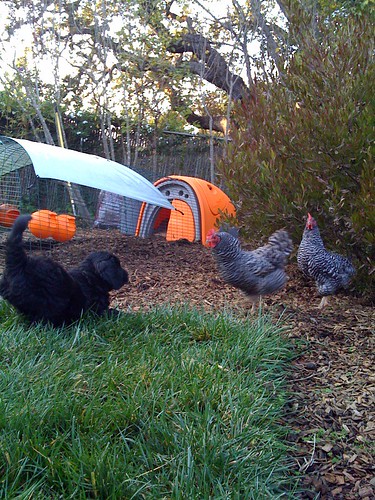
We're trying to slowly introduce our new puppy, Kairos (he's a golden doodle), to Sophia and ZsuZsu, our two urban chickens. For the most part, they've been admiring each other through the wire of the Eglu's run, but now we're letting them both run free at the same time.

Bet you can guess who got his nose pecked shortly after this picture.

All part of the socializing process.

Tuesday, December 2, 2008

stoopid chicken tricks: head tracking

I'd noticed this ability to keep their heads in one place no matter what the body does in my own chickens, but I think it's great to see it called out in isolation in this video.


As stated in the video, the ability to isolate the head from all other body movement is quite handy hunting for bugs and moving quickly over changing terrain. This ability has also been transferred via technology to steadycams and the same principle is found in our cars' suspension systems, yes?

What other useful applications for this ability are there?

Thanks to LaughingSquid for the find!

Sunday, November 30, 2008

Orwell was an urban chicken farmer

And, per his now-blogged diary, an obsessive one at that:
30.11.38: Two eggs.

29.11.38: One egg.

28.11.38: Two eggs.

27.11.38: One egg.

25.11.38: Two eggs.

24.11.38: One egg.

As for our own chook's egg production, we're in a dry spell right now as Sophia is heavy into her molt and I suspect ZsuZsu's not far behind. Back to the store bought eggs for a bit... sigh.

FWIW, I like Steve's Egg Record 2008 both because it's on a wiki, and the format's pretty cool, too. He shared it with me in response to my recent molting post.

Hat tip to boing boing and Ed Vielmetti for the Orwell egg post.

Monday, November 24, 2008

molting chickens are ugly chickens

re-feathering the back So, at eighteen months of age, Sophia has finally started to molt and what an unsettling experience it's been for all of us! (She's hiding her head in shame in the picture to the right)

Why do the chickens molt? Courtesy the fine crowd over at Wikipedia:
The process of moulting in birds is as follows: First, the bird begins to shed some old feathers, then pin feathers grow in to replace the old feathers. As the pin feathers become full feathers, other feathers are shed. This is a cyclical process that occurs in many phases. In general, a moult begins at a bird's head, progresses down the body to its wings and torso, and finishes with the tail feathers. It is usually symmetrical, with feather loss equal on each side of the body. Because feathers make up 4-12 percent of a bird's body weight, it takes a large amount of energy to replace them. For this reason, moults are frequently timed to occur right after the breeding season, but while food is still abundant. The plumage produced during this time is called postnuptial plumage.

Our first clue the molt was coming to our was Sophia's starting to look a little threadbare around the neck and we could see some small feathers littering the mulch in and around the coop and run. Then, egg production dropped to one a day and we had our first zero-egg day in I can't remember how long.

And then it happened: Sophia lost all the feathers on her back and from her tail, from between her wings down to her tail bump (not the technical term, but you know where I'm talking about).

While I'm sure she's as mortified by her looks as a chicken can be at her state, I have to admit I am intrigued by the feel of a chicken's bare back: the skin is warm and a little clammy, quite a change in temperature from the carcasses we get from the butcher.
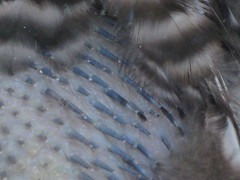
close-up of the new feathersBut the bareback phase lasted only a day, as pinfeathers (seen at left) are sprouting up all across her back. I'm amazed watching how quickly these things grow. In the picture, you can see the newest are on the left and the oldest are on the right. Evidently, our Barred Rocks are "late molters" and this shedding/re-growing is going to last 2-3 months total and then Sophia will be back in full production, per Mississippi State University Extension's info on molting of laying hens:
Each year chickens molt, or lose the older feathers, and grow new ones. Most hens stop producing eggs until after the molt is completed. The rate of lay for some hens may not be affected, but their molting time is longer. Hens referred to as "late molters" will lay for 12 to 14 months before molting, while others, referred to as "early molters," may begin to molt after only a few months in production. Late molters are generally the better laying hens and will have a more ragged and tattered covering of feathers. The early molters are generally poorer layers and have a smoother, better-groomed appearance. Early molters drop only a few feathers at a time and may take as long as 4 to 6 months to complete the molt. Early molters are usually poor producers in a flock. Late molting hens will produce longer before molting and will shed the feathers quicker (2 to 3 months). The advantage of late molters is that the loss of feathers and their replacement takes place at the same time. This enables the hen to return to full production sooner.
Things we need to pay attention to as the molting progresses are to keep the protein intake high so as to make regenerating the feathers easier on the girls. I'll try and toss in some dairy, too. Although I've read in some other chicken blogs that the owners have given their girls raw meat, I'm a little squeamish at the thought of my chickens being meat eaters.

For those of you who've been through a molt or two, what experience can you share to help us first timers make it to the other side with our wits about us (and fully feathered chickens, too)?

LinkWithin

Related Posts with Thumbnails