Showing posts with label food. Show all posts

Monday, February 11, 2013

Growing Your Own Urban Chicken Feed

Flickr photo credit: MrsEds
One of the benefits to raising urban chickens is their willingness to eat just about any food scraps tossed their way and turning that food into delicious eggs.

A quick "chicken feed" search of YouTube videos shows all kinds of variety in what we're feeding our backyard girls: Army Worms, redworms, herbs, special grain grasses, home-milled seeds and grains. Vegetable trash from the local coop grocery, brewery waste, and many others make the list, too.

While commercially produced feeds are available to us urban chicken farmers, the girls seem to do better when they're eating more than what comes from the bag. But is this really good for our chooks?

I've been talking with a formally trained Ag Professional named Jim Ehle who's doing research into how urban chicken farmers are supplementing commercial rations with other fed options. If you supplement commercially produced feed (or skip it altogether) for your urban chickens, Jim would like to hear from you via email. Specifically, what are you feeding them, and is it good for them?

Of course, I'm always happy to have folks share their wisdom here in the comments, and Jim offers to identify and make reference to all that respond if he uses their information in his report/white paper. Also, he will provide a link to your blog, business, or website as a way to say thanks for providing your experiences.

Thank you in advance for sharing your urban chicken feed experiences! 

Thursday, January 31, 2013

GMOs: Knowing what's in your food, and mine

I've just finished watching the film Genetic Roulette, and I'll never look at the food on store shelves the same way again.

I've also voted for the film to receive the AwareGuide Top Transformational Film of 2012. It's that good.

As an urban chickens fan, I hope you'll join me in doing the same, and for your convenience, the film is embedded below:

Now, one of the many benefits of raising urban chickens is our ability to control exactly what our hens eat as they produce the eggs we then eat ourselves.  This kind of food sourcing control gives us the power to decide to take the time and effort to produce organic eggs from free range hens. Whether we go through that effort is ultimately up to us, but at the very least, we're well aware of what our hens are eating. We know where our food is coming from.

Would that this knowing were true of all the food we eat here in the United States. There's significant pressure from the food industry, via Monsanto, et al, to keep us consumers from knowing whether there are GMOs in the food we buy at market. The Europeans are ahead of us in labeling all the GMO food produced over there. We've got to do the same here, especially after the millions of dollars that were spent by the food industry defeating Prop 37 here in California last fall.

Please take a moment now to visit this AwareGuide page and vote for Genetic Roulette to receive the AwareGuide Top Transformational Film, 2012 award.

Sunday, January 31, 2010

Fresh grass for urban chickens all year long

Urban chickens love their greens, sometimes (often?) to the detriment of existing landscaping. Hens don't much care how much a plant costs you to replace, they just care if it's yummy or not.

Yes, there's been many an urban chicken farmer who, with best intentions, has moved their run on top of the grass for a day or so only to come back to find a patch of dirt under some rather content hens. So, how to provide your girls with greens, especially when it's still cold and snowy out still (in most of the country, at least)?   

Mary D was kind enough to send me an email sharing her instructions for providing fresh greens to your urban hens.
I get unhulled seed, (whatever is available) at our local Co op, and rotate four trays of seed growing continuously. When I start seed, I lay it down thick on potting soil, cover with a piece of newspaper, keep the newspaper moist, and keep covered with a plastic wrap, until seed really gets sprouting.

I do all of this on a grow rack in our house throughout the winter and each day our hens get a 1/2 flat of fresh grass.

This is wheat berry growing in the above pictures, but I experiment with any grain I can find. They love it!
As soon as one tray is empty I start another. From seed to "chicken ready" is usually 7 days. 4-6 trays keep you in grasses for 8 hens.
Bonus: you can find all kinds of quantities of grass seed ready to be shipped from Amazon.

Thanks for the tip, Mary. I know you're making a lot of snow-bound urban chickens very happy!

What do you do to keep your urban chickens getting their greens during the long winter months?

UPDATE: Derek, from mypetchicken.com, chimes in with this little tip he got on growing grass in trays: "add a hardware cloth top to the trays (might have to make the trays out of wood) and let the grass grow through.  This way the chickens can eat the grass, but not scratch up all the dirt and require reseeding the trays every time.  You can cycle a couple of the trays so that they always have fresh grass"

Thursday, October 15, 2009

urban chickens help with climate change

It's not hard to see that keeping urban chickens are part of at least two of the solutions published in Scientific American's 10 Solutions for Climate Change.

Consume Less: cutting back on consumption results in fewer fossil fuels being burned to transport products around the globe.

By keeping hens in your own backyard, you're able to cut back on the transport requirements from manufacturer to your house for several items at once:
  • eggs: instead of trucking and refrigerating eggs en masse from the farm to your table,  you simply walk across the yard and collect your own. Bonus: yard-collected eggs can sit on your counter at room temperature until ready to use (within a month of collecting).
  • herbicides and pesticides: if you're letting your hens free range around your yard, you no doubt have discovered how good they are at eating many weeds and bugs that you'd otherwise have to spray to control.
  • fertilizer: with hens in your yard, you've got prolific nitrogen-producing machines that'll get your compost bin producing rich fertilizer in overdrive.
Eat Smart, Go Vegetarian? Organic produce is often shipped from halfway across the globe. And meat requires pounds of feed to produce a pound of protein. Choosing food items that balance nutrition, taste and ecological impact is no easy task.

By keeping chickens in your backyard as part of a larger gardening experience, you know exactly where your veggies have come from (and where the fertilizer is sourced, too). Moreover, you've got a great source of low-cost high-quality protein produced for you almost every day: the egg.

No need to go vegetarian to lessen your impact on the climate, and no need to eat the birds themselves. A couple backyard hens can produce a dozen eggs a week for you which provides plenty of protein as part of a sensible diet.

As part of Blog Action Day, take a look at the rest of the 10 Solutions for Climate Change and add to the comments any ways you find urban chickens are part of on of the solutions.

Thursday, October 8, 2009

knowing where your food comes from

This past Sunday, there was an eye-opening article in the Sunday New York Times about Stephanie Smith, a 22-year-old dance instructor who remains paralyzed from a food-borne illness caused by e. coli which came from a hamburger she ate.

The offending hamburger came from a batch of frozen burger patties shipped by agri-conglomerate Cargill. The batch was made from slaughterhouse trimmings sourced from plants in Nebraska, Texas, South Dakota and Uruguay(!) and assembled in a plant in Wisconsin before shipping out as "American Chef's Selection Angus Beef Patties." Given the varied and distributed sources of ingredients for these patties, it's amazing we're not reading of plights like Ms. Smith's more often.

Or are we?

In today's NYTimes blog, Timothy Egan has a lovely yet scary post from the Yakima Valley in Washington state launching off the groundwork of Sunday's column and reveals that there are more than 70 million cases of food-borne illnesses a year in the US, resulting in 5,000 deaths. Egan's post is worth the read, but if you're lacking time, here's the conclusion (what inspired me to write today):
How much of the danger from leafy vegetables can be blamed on the industrial model that produces cheap calories I don’t know. But as consumers follow Michael Pollan’s advice to get to know our food producers, we will learn to see the processed burger and the industrial vegetables for what they are — cheap global commodities that carry some risk.

The best antidote for such a thing is to see, touch and experience food as it comes off the fields. As imperfect as this harvest picture is, it satisfies a need that has never bred out of us as people.
And as I look out the window at my urban chicken coop, I enjoy an even greater comfort that I know exactly where my eggs are coming from, and exactly who handles them from nest to kitchen.

Let's hear it for urban chickens and urban farmers everywhere for reducing the food sourcing risk.

Photo credit: estherase on Flickr

Wednesday, February 11, 2009

a chicken's life inside the battery cage

The folks at Animal Visuals have put together an interactive media experience (embedded below) that allows you to see and hear what it's like to be a chicken in a battery cage. Mind you, this is the experience that 300 million egg-laying chickens are forced to endure here in the USA their entire lives.


See the Animal Visual page for the list of facts about battery farming or download the battery cage facts PDF here.

More than ever, I'm convinced we need to find a way to legalize urban chickens across the country to get our birds out of conditions such as this.

Monday, March 3, 2008

our hens are scratch-hooked monsters

For the last couple months or so, in addition to the layena crumbles, I've been slipping our chickens some scratch. Hen scratch to be specific: cracked corn and seeds and whatnot.

Hen scratch has the comparative nutritional value to chickens that popcorn has to humans: which is to say, not much. So we make sure not too give them too much scratch or they'll fill up on the junk and not eat their nutritionally superior layena, not to mention all the juicy bugs and weeds in the yard.

But our girls love their scratch, and that's really an understatement. We don't give them a lot of scratch (maybe half a handful to entice them back into the Eglu when we're done letting them free-range the yard), but they go nuts tripping over themselves to get to me every time I approach the container in which we store the scratch.

Up until I introduced scratch to their diets, I'd only ever seen them go nuts over grapes (see the video here). I'm thinking of conducting an experiment next weekend where I put a pile of grapes on one side of the patio and a pile of scratch on the other and film what happens.

I'll be sure to post the results to YouTube (and here to the blog, too).

After this small bag of scratch is gone, I think I'll cut them off, ahem, cold-turkey. The girls have got a lot of weeds and bugs to devour now that Spring is here.

Monday, January 14, 2008

another 50 pounds of chicken feed into the bin

We opened up another fifty pound bag of Purina Layena Crumbles, so it's time for my usual "I just bought food, how much does a yard-fresh egg cost us?" post:

With this bag of food, our girls have now consumed one hundred fifty pounds of laying feed in the four months since our first egg back on September 8, 2007.

Doing a little back-of-the hand calculation, that means we'll go through almost a quarter ton of chicken feed in a year. At $12 per 50-lb bag, that means we'll be paying approximately $120 in feed costs for a year's worth of eggs.

If our two girls continue to average a dozen eggs a week between them, we'll be looking at approximately 50 dozen eggs over that year.

That means each dozen will cost us approximately $2.40 (leaving out the sunk costs to purchase their Eglu).

Not a bad price for a dozen delicious eggs!

Oh, and I noticed something odd on my receipt from San Mateo Pet Supply (where I buy our chicken feed). I'd decided to treat the girls with a couple pounds of hen scratch in addition to the Layena Crumbles.

While the Crumbles were not taxed, the hen scratch was taxed. What up with that? I guess chicken snacks are like people snacks: taxable!

Wednesday, January 9, 2008

what it's like to be a REAL chicken farmer

I just had to share with you this great article, From Friends to Food, telling what it's really like to raise chickens for food (eggs and meat) as a farmer.

This is not a tale of the goings-on in one of these industrial chicken processing behemoths, but instead what it's like to run a mom-and-pop outfit. To wit:
We don’t have rows of vast chicken houses holding 10,000 birds each. Our chickens live real chicken lives. They know what hawks are. Ellie, 9, and Levi, 7, are old enough now to get it. They understand it’s our responsibility to give these chickens the best lives possible with the realization that they will be food.
And interesting stats:
According to the Farm Aid advocacy group, there are nearly 5 million fewer farms in the U.S. than there were in the 1930s. Of the 2 million remaining farms, only 565,000 are family operations.

[Story author] Dean Mullis, 46, and his wife, Jenifer, 43, are among them. They own and operate Laughing Owl Farm, on five acres northeast of Charlotte, N.C. In addition to raising chickens and turkeys, they raise vegetables using organic methods.
Reading Dean's account makes me realize I should more appropriately refer to myself as an "egg farmer," but I'll stick with the grander-sounding "chicken farmer" label for the short term, at least.

In any case, enjoy the story!

Wednesday, December 5, 2007

our third 50 pound bag of feed

Just recording the fact I bought our third fifty pound bag of feed this week. We'll likely need to break it open this weekend.

This means they're consuming about seven pounds of food per week (at 24 cents per pound in bulk) to generate a dozen eggs. That's $1.68 a dozen... still an unbeatable price for yard-fresh eggs!

Friday, September 21, 2007

two egg-layers in production

I'm happy to confirm both chooks are now laying eggs! (whew, no roosters)

And we had Twinga over for breakfast this morning to share in our egg bounty. Two eggs each for the three of us: Twinga's were sunny-side up, mine were over-easy and Left Coast Mom's were scrambled (just like she likes them). I'm still amazed that these eggs are coming from our own chickens, and I wonder how long it'll be before the novelty wears off.

Thinking back over the anatomical changes that ZsuZsu's gone through in the last ten days, I realize I need to take some pictures to show just how mature the girls are looking now.

While they're producing perfectly shaped (but small) eggs, they're starting to look like full-grown hens.

And to think it was just five months ago that I could hold them each in the palm of my hand with room to spare.

Wednesday, September 19, 2007

New to Urban Chickens? here's a recap

Great to see all the folks coming in from hearing our update on Spark.

I've pulled together this "highlight reel" to help orient you into how we've become urban chicken farmers here in Redwood City, California, USA:

Enjoy!

Never heard of Spark? Go give a listen to the podcast of this new Tech & Trends radio programme on CBC Radio. We're at the 16:00 mark of this week's episode, and you can see the notes around our first Spark appearance from an earlier post.

Monday, September 17, 2007

seven eggs in ten days

Just a quick update to say Sophia's broken her egg-laying pattern by delivering her seventh egg today.

Before leaving for work, I'd wondered if she was going to stick to her three days on, three days off, three days on pattern by skipping the day.

To my delight, I picked an egg out of the nesting box after work as I was adding newly purchased Layena crumble to the food bowl.

ZsuZsu's still showing no sign of being ready to lay, although her hips are starting to spread farther apart. Maybe she'll start contributing to the egg basket in the next couple weeks?

Oh, and we've lined up our first breakfast guest to enjoy our yard-fresh eggs. D's due to come over Friday morning, just a week shy of her flying back to Germany for good.

Gotta figure out the best way to showcase the taste of the eggs. Perhaps we'll just go over-medium again for full effect.

Sunday, September 16, 2007

our chickens are finicky eaters?

First off, I'm happy to report that we've just gotten yet another egg from Sophia, for the third day in a row. This means that over the last nine days she's gone three days on, three days off, three days on again. Can't wait to see what tomorrow brings (egg or no) so I can see if we're indeed in a pattern here.

On the other hand, she might not be laying anything tomorrow because she doesn't seem to have eaten much over the last 24 hours. Let me explain...

I'm experimenting with what kind of food I give the girls before jumping in and getting a 50 pound bag of one particular type. I tried the Layena crumble, and the girls seemed to like it quite a bit (they wolfed it down, mixed in with the scratch). This last week, I picked up some Layena pellets and topped off their feed bowls with the pellets yesterday afternoon.

Flash forward to this afternoon, and I noticed the girls were a bit more agitated than usual. Even after I collected the egg out of the nesting box, they were still pacing and clucking like something troubled them.

I went upstairs to put the egg in the fridge and brought a fist full of grapes down to the coop for the girls to eat and that's when I noticed that the food bowls looked like they hadn't been touched in the last day.

Seems my girls don't care for the pellets. At all.

Being the concerned chicken farmer I am, I then sat down and crumbled up the pellets so they'd be more appetizing to the girls (I hope, at least).

We'll see what the food level looks like tomorrow afternoon.

I'm just glad I don't have to crumble up 50 pounds of pellets!

Tuesday, September 11, 2007

yummy yard-fresh eggs

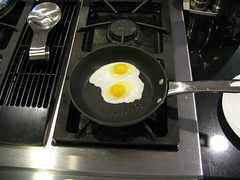
fresh eggs frying This morning, I cooked up our first "yard fresh eggs" (doesn't sound as good as "farm fresh" but it's technically correct).

As you can see by the photo at right, I made them over-medium just to be able to watch them cook up on their stiff whites and to get that golden ooze of a fresh yolk.

The biggest surprise in cooking them? The egg shells are so hard! Over the years, I've learned (by rote) how to open an egg with one hand, using just the right amount of force to crack the shell so I can spill out the contents. I'm going to have to re-learn the skill with these fresh eggs now.

And I gotta tell ya, it's going to be hard to eat the store-bought eggs after this morning's exercise. Sure, I'll be able to put store-bought eggs in batters and such, but eating eggs in isolation? (omelets or scrambles or over-mediums?) It'll have to be yard fresh eggs for me, thanks.

If you click on the picture of the eggs in the pan, you'll get to the rest of my Flickr stream showing Sophia's first three eggs in a bowl, and the aforementioned golden yolk ooze. YUM!

Saturday, September 8, 2007

OUR FIRST EGG!!!!

Hannah holding Sophia's first egg As if she were waiting for the second broadcast of Spark, Sophia laid her first egg today!

We noticed the clucking of the girls was a bit different today than usual, and when we went out to let them free range this afternoon, our peek into the nesting box was rewarded with our first egg. I'm so proud of Sophia!

You can see our oldest, Hannah, in the picture to the right holding the egg in her hands, trying her hardest not to shake it up to find out what's inside (her prior experiences to finding eggs in the yard have all been at Easter time, so she likely thinks any egg found in the yard was left by the Easter Bunny and contains something chocolate-y inside.

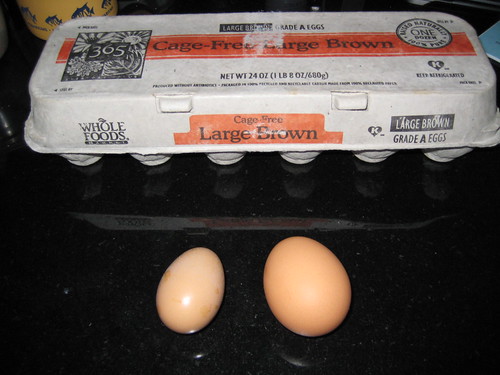
To give a better idea of how big this first egg is in comparison to others, here's a shot of Sophia's egg (on the left) next to a store-bought USDA Grade A large egg (on the right):

first egg comparison

And how do we know it's Sophia's egg? Well, we didn't see Sophia do it, but she's definitely the more mature of the two girls, as her wattles are starting to drop, and her "hips" seem to be a bit farther apart and the vent area (between tail and legs) is a bit fuller than ZsuZsu's.

Maybe this'll inspire ZsuZsu to develop a bit faster?

Hooray! we're now in eggs!

Wednesday, August 15, 2007

properly feeding our chickens

As we approach the arrival of our first eggs, I'm starting to do research about changing the feed of our girls to best support their egg laying efforts.

At our local feed store, there are five bins of chicken food. All are available in 50 pound bags, but until we get into the egg-laying stage, I won't be buying in bulk:
  1. starter (don't need it anymore)
  2. chick scratch (what we're giving them now)
  3. hen scratch (for post-egg-laying years?)
  4. Layena(R) mash (for egg-laying hens, and suggested as a good iguana food, too!)
  5. Layena(R) crumble (crumbled quasi-pelletized versions of the mash)
In my quest for more detail on what to get (mash or crumble), I discovered a Geocities-hosted page from the (no defunct) Chicken Encyclopedia's page on Feeding.

Advice is given on what to feed the chicks weeks 0-4 and post week 18 but nothing in the middle. However, I found this section on scratch (what we're feeding the girls now):

Keep in mind once you start feeding them scratch or cracked corn you also need to add a supply of grit for digestion. As you have guessed chickens do not have teeth, without getting to technical, the grit is stored in the chickens gizzard and as the food they eat passes through the gizzard it is ground up.

A good way to check out the gizzard is after you have given you new chickens grit pick one of them up the next day and feel the base of her neck, you should feel a lumpy pocket that is the gizzard.
Uh oh. The girls have been on scratch for a good 8 weeks now (or more) and I've yet to give them any scratch. They've continued to grow quick as a, um, chicken, so I think they're getting the nutrients they need. They must be picking up all the grit they need in their free ranging the yard (I hope!). I'll be getting grit for them asap, though.


Another interesting thing I noticed on that same Feeding page was the following caution (in an annoying blink style font held over from 1995):
The things chickens should NEVER get:

Large amounts of salt, raw potato peels, chocolate

and the biggest NO NO of all do not ever feed beans of any kind to a chicken (they can't expel the gas and it will get ugly so please do not try it)
Ewww.

Oh, I'll be switching the girls to a laying feed once the first egg comes out. Still haven't decided which brand yet (will keep you posted)

Monday, August 6, 2007

my how the chicks have grown

I think the girls have put on a couple pounds in the last ten days I've been away. I can definitely see evidence of growth both in their girth as well as in the size of their combs. Still waiting for their wattles to form in earnest, however, as they're still just hints of a fold of skin where human "cheeks" would be (are there such things as chicken cheeks?). Hard to believe they'll be laying eggs in a month's time.

From the feel of it, the girls also seem to have grown a bit more short-tempered at being cooped up in the run all day. When I reach for the door in the run to let them out today, Sophia gave me a nice peck on the finger. Not enough to break the skin, but enough to smart a bit. Perhaps it was the fistful of grapes I had? Nah... she's just letting me know I was gone too long.

So, on my trip up to Oregon, I saw evidence of chickens in most of the small towns (pop < 1,500) I rode through, but the only time I really saw chickens was one morning after waking up from camping in Cherry Creek/"Ham" Bunch County Park outside Coquille. Well before dawn (talking 5:30a, here) the roosters in the backyard next to the park started to crow, waking me up from a deep sleep. After another couple hours of their crowing, the owner sauntered out into the yard and over to the chicken run.

He opened the door and quicker than you could say "look at all those chickens!" there were a good dozen chickens sprinting in as many different directions out into the yard. From what I could see, the backyard flock consisted of equal parts bantam and regular chickens... and while I'm not expert, I know I saw some Plymouth Rocks, some Rhode Island Reds and a couple Australorps. As I was busy watching the chickens sprint to their piece of the yard, the owner was busy collecting eggs inside the coop, and when we finally started walking back to the house, I swear he had ten or so beautiful eggs in his hands. He was too far away for me to call out and get his attention, and in any case, I felt a little awkward at being so overjoyed to watch someone collect eggs from his backyard. Shortly after the egg collection was carried into the house, I'd packed my motorcycle and was gone for the day's ride.

Can't wait until my own mornings are filled with fresh eggs.

While I'm waiting, though, I was pleased to find this little video gem (courtesy BoingBoing) showing Petaluma Poultry girls making a huge omelet back in 1932.

Monday, July 23, 2007

far-sighted chickens and new eating patterns

I've noticed recently that the girls can recognize me from over 50 feet away.

As soon as I walk out the back door of the house, the girls rush to the front of the run and quickly pace back and forth waiting for me to come let them out to free-range in our backyard. Not saying they're sitting there waiting for me to emerge from the house, but I don't think I'll ever be able to sneak out to the back porch without getting their hopes up that it's free-range time.

I knew they were able to spy tender morsels (bugs or mushrooms or other goodies) in the grass that I easily missed, but this far-sightedness surprised me. I thought there was a trade-off to be made: you can be near- or far-sighted, not both. Take your pick!

Poking around the web a bit leads me to this article on Prairie Chickens as told by a hunter, and all he says seems to support the notion that chickens have particularly good eye sight. Huh. Go figure.

Moving on to eating matters: the girls are starting to gobble up their food as if there's no tomorrow. We went through the last seven pounds of chick scratch in just three weeks, and I know very little of it was due to sloppy eating habits. Yes, we've now got a bunch of other birds (sparrows, thrushes and the like) who've decided they like hanging around the outside of the chicken run to eat what the girls slop out of the enclosure, but they don't slop too much.

If I had a better understanding of just how voracious they'd become before starting to lay, I could get bulk food. But as it is, I'm just buying it by the pound out of a bulk bin instead of getting a big pre-filled bag.

I got twelve pounds of chick scratch this past Saturday, and I'm hoping that gets us really close to Time of Lay. By my calculations, we should have our first eggs shortly after Labor Day (hooray!).

I'm just hoping they learn to stay out of the nesting area and stick to the roosts before we get to the laying season. (that's another post entirely)

Wednesday, July 11, 2007

video of the grape chase

Following up on this morning's post about our chickens' grape race, I shot some footage of the girls in action on my Treo. Pardon the quality of video, but you get the gist:


LinkWithin

Related Posts with Thumbnails