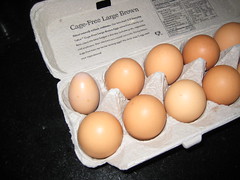
Showing posts with label egg. Show all posts

Monday, April 22, 2013

Why Urban Chicken Eggs Are Green

No matter the color of your urban chicken eggs shells,
they're all green at their core, and by that I mean green as in "sustainable," not green as in "eww, to the compost heap with you!"

Indeed, if you're doing what wise backyard chicken farmers do and keeping your unwashed eggs on the counter (in something like this Stoneware 12-Cup Egg Tray), your eggs are increasing your sustainability footprint in a big way:
  • turning locally-sourced scraps, bugs and weeds into a nitrogen-rich fertilizer for your plants
  • turning locally-sourced scraps, bugs and weeds into nutritious protein sources for you
  • cutting the carbon footprint of your protein sourcing from miles to meters
  • cutting the refrigeration costs to nil if you've got counter-top eggs
So on this Earth Day, pat yourself on the back for being at the head of the sustainability curve and throw a little scratch to the girls to thank them for doing their part, too.

Flickr photo credit: pinprick

Thursday, April 18, 2013

Stop washing your eggs!

It's hard to resist making eggs pretty when they're removed from the nest. But washing your urban chicken eggs is just about the worst thing you can do to them. The first few eggs we got from our hens, I promptly took them out of the nest and straight to the sink to wash off the dirty bits. Can't have any feathers or dirt (or poop!) clinging to the outside of the egg, nosirree.

A clean shell means a good egg, right? Wrong.

My desire to have clean shells was born of all those years buying eggs in the store. My mother taught me to always open the carton at the shelf to see if there were any cracks or breaks or other reasons to try another carton. And I learned that a carton full of clean white shells meant they were good eggs. And good eggs were always refrigerated properly, just like it says on the carton.

Fast forward to my urban chicken years, and I've come to learn something very, very different about eggs farmed from the backyard: once the egg is removed from the nest, there's really no intervention required. Not even refrigeration!

Why? Well, just before the fully-formed egg passes out the vent of a hen, her body adds a moist, protective coating called the bloom. This wet bloom dries quickly when the egg lands in a nest and it becomes a protective shield, covering all the pores in the egg so bacteria and dirt (and even air) can't get inside the egg. The bloom also traps moisture inside the egg so the yolk and albumen don't dry out.

This coating is why eggs can be left out at room temperature for weeks, if not months, and still be edible. This coating is also why a hen can save for several weeks to keep a clutch of a dozen eggs or more in her nest before sitting on them to incubate them into little chicks.

When we wash eggs, we actually remove this bloom, this protective coating, from the shell and at best, make it possible that air gets into the shell and degrades the albumen and yolk (making them runny and less nutritious). At worst, we're effectively pushing the bacteria that was outside the egg shell through the pores and into the inside where it wreaks havoc until we open it. This havoc is only slowed down by our refrigerating the eggs.

So what to do instead of washing your eggs? Try keeping a bit of sandpaper by the coop to sand off any stuck bits. Or a fingernail brush to brush off bits of nesting material, feathers or poop. Just do your best to keep your eggs dry and the bloom intact so nature can protect your eggs as they sit beautifully on the counter.

And if you must, must, must wash them? Do it just before you eat them.

Thursday, March 28, 2013

Urban Chickens As Salmonella Carriers? Wash Your Hands!!

This past weekend, Seattle NPR-affiliate KPLU posted Backyard Chickens: Cute, Trendy Spreaders of Salmonella, an article by Nancy Shute. To save you the read, here's a synopsis of the article: sensationalist headline, some scary statistics from an outbreak of salmonella tied to a particular hatchery, concludes with the common-sensical "the CDC says wash your hands to reduce the risk of spreading the disease."

There's a lot of simple wisdom in that directive from the CDC: wash your hands. In fact, the CDC directive applies to reducing risk of transferring diseases to humans from any animals. Well, except for the danger cats pose to pregnant women.

Looking back over four years ago, I published on this blog a series of posts exploring some of the more common concerns I see raised in the debate to allow urban chickens:
Time to blow the digital dust off those posts as we get into the season renewed urban chicken interest. What's old is new again.

Flickr Photo credit: Microbe World

Sunday, March 24, 2013

When to expect that first egg


Photo credit Eric Rice
Chickens, as a species, reach maturity to start laying eggs anywhere between 17 and 26 weeks, depending on the specific breed. This age is referred to as a chickens "point of lay."

Calculating a chicken's point of lay is akin to looking on the back of a seed pack and seeing how many days it takes to harvest the vegetable you're thinking of planting. Some chicken breeds mature earlier than others, so you can take that into account as you're planning your flock.

Aspiring, but impatient, backyard egg farmers can buy pullets at "point of lay" which means they'll be enjoying fresh eggs within a week or so of bringing their hens home. But there's a cost to buying pullets at point of lay, and that's the cost of missing out on watching chicks grow up to be pullets and the imprinting of these chicks on you as their "mother hen."

So there's a bit more planning involved for those of us who are interested in raising our hens from the time they are day-old chicks. The 17-to-26 week guidance is a spread of a full 2 months, in other words, the difference between enjoying your first eggs on Labor Day or on Halloween(!).

Now, as you make plans to start raising chicks, remember to circle a date 4 and a half months after you bring them home as the day to start expecting eggs. Our Plymouth Rock chicks took 20 weeks to lay their first egg, and I have to admit those last three weeks of waiting (from week 17 to week 20) were excruciating!

Friday, March 15, 2013

Make it the People's Choice: The Story of an Egg

UPDATE: While it didn't win the People's Choice Award, The Story of an Egg was the most viewed film of the festival!

The 2013 PBS Online Film Festival is underway, and one of the films up for consideration for the People's Choice Award is The Story of an Egg. Now through March 22 is our chance to recognize it with a People's Choice Award at the festival.

In explaining what it means for chickens to be "pasture-raised," this short film does an excellent job of reminding us why it's so important to treat our hens well. At the same time, the film makes us smarter to be wary of the messaging that marketers employ to make us think industrial hens are being treated better than they actually are.

Longtime blog readers will remember my original post about this film when it first debuted online last Spring. For the benefit of newer readers or those who missed it the first time, the short film is viewable in its entirety below.


Please take a moment to vote for the film today, thank you! (The ballot page lists all films in alphabetical order, so scroll down to "S" to select the film)

Friday, November 2, 2012

Friday night thriller for the hen house

In honor of the spooky season so close in the rear view mirror (and my own recent viewing of Prometheus), here's a fun short, "Of Eggs and Aliens" that's sure to thrill the girls in your coop.


Tuesday, May 15, 2012

What does a cage-free, free range egg look like?

Got urban chickens but still stuck buying eggs from the store? This is an awesome six-minute video from The Lexicon of Sustainability that demystifies the marketing terms of "cage-free" and "free range" for what they really mean (gimmicks at best).


Great to see Alexis Koefoed of Soul Food Farm, among others, show just what the literal term "Pasture Raised" means to both us as consumers and our hens as producers

Thursday, August 19, 2010

Happiness is knowing where your eggs come from

Photo credit: Wombatunderground1 on Flickr
A store-bought egg recall? Again? Well, thank goodness for our own backyard egg producers!

It's staggering to think that Wright County Egg is recalling 380 million eggs since improper handling at several of its facilities has been suspected of sickening hundreds of people with salmonella. For now, I'll leave the "how did this happen?" story to be told over on the news web sites.

I imagine we'll be reading a lot about federal regulations and industrial processing plant working conditions and distribution chains in the coming days before this story dies out.

What I hope people think about is the plight of the millions of hens who actually laid those 380 million eggs now recalled (for destruction if they haven't been eaten already). Thanks to human negligence and mishandling, all the energy expended to create and deliver those eggs into the industrial system has been wasted. And this coming from a creature that spends its life laying eggs in a space only as big as a standard letter-sized piece of paper. It hurts to think about it.

If you've had to buy eggs at the store since May, please check to see if you need to return your eggs.

And the next time you step out to the coop to pick an egg from the nesting box, please give your hen a hug.

Friday, May 7, 2010

take a video tour of a large-scale egg farm

If you're keeping a small flock of your own, you know what it's like to collect a handful of eggs from your coop each day.

So, what's it like to collect and process over 1.7 million eggs a day!?

There's a fascinating video posted over on the USA Egg Farming site that gives us a behind-the-scenes look at large-scale egg farming at Willamette Egg Farms in Oregon.

You can see a breakdown of the difference between raising hens caged versus cage-free (they do both), both in terms of hen health and production costs.

I found it quite educational to see and learn about the inside of their modern hen house that holds 188,000 egg-laying hens in a clean, cool environment. It's a far cry from the stinky houses of old that are permanently etched into the brains of anyone who's against the idea of urban chickens.

Yes, this video is clearly part of large-scale agriculture propaganda, but that doesn't take anything away from my fascination of the process by which so many eggs are produced for the population at large (at least until everyone has a chicken in their own backyard!)

Monday, April 26, 2010

Secret Gardens of the East Bay Follow Up

I had the pleasure of talking all things urban chickens with a group of people who were participating in the 24th Annual Secret Gardens of the East Bay tour over in Oakland yesterday. It was a delightfully beautiful Spring day outside (sunny, mid-70s) and I was impressed that the group of about 30 or so people actually chose to cram into a small classroom to listen to me and ask good questions.

I promised I'd provide them links here on the blog to the urban chicken resources I listed in my blog, so without further ado, a shout out to the following people/places to get your urban chicken on:
  • BackyardChickens.com - a strong online community of backyard chicken enthusiasts and just about any question you have about the cluckers, someone at BYC will know the answer.
  • MyPetChicken.com - a wonderful online source for small quantities of just the breed of chicks you're looking for. They've got lots of other good chicken supplies and paraphernalia, too, and don't forget to consult their Chicken Selector Tool to help you narrow down your choice of chick!
  • FeatherSite.com's Poultry Page - While it hasn't been updated in over a year, the content about chickens is timeless (and rest assured chickens haven't evolved enough in the meantime to warrant any updates).
  • Yahoo! Groups related to chickens (like San Mateo Chickens and Silicon Valley Chickens)
  • 4-H Clubs
  • Meetups
And a big thank you to Nina for coordinating the speaker series and the gift of the awesome Slice of Organic Life book. I can't wait to put the ideas in the book to practice!
Finally, be sure to check out the Poulet Chalets article in yesterday's San Francisco Chronicle. It covers much the same information I did in my presentation (but it's in handy-dandy written form).

    Tuesday, February 23, 2010

    Flock Observations with Chicken as Muse

    It's time to share yet another beautiful essay crafted from spending time with a flock of chickens.

    This particular essay, Pecking order, was written by Peter Lennox and appears on the Times Higher Education site.

    I can't possibly do justice to Lennox's words, so I'll merely quote a paragraph that really speaks to me (I got my degree in Linguistics from UC San Diego, so all things word-y appeal to yours truly):
    Watching chickens is a very old human pastime, and the forerunner of psychology, sociology and management theory. Sometimes understanding yourself can be made easier by projection on to others. Watching chickens helps us understand human motivations and interactions, which is doubtless why so many words and phrases in common parlance are redolent of the hen yard: "pecking order", "cockiness", "ruffling somebody's feathers", "taking somebody under your wing", "fussing like a mother hen", "strutting", a "bantamweight fighter", "clipping someone's wings", "beady eyes", "chicks", "to crow", "to flock", "get in a flap", "coming home to roost", "don't count your chickens before they're hatched", "nest eggs" and "preening".
    In the essay, Lennox makes great observations about chickens' environmental preferences and territoriality, their personality traits and behaviour and their inquisitiveness, teaching and learning.

    If you have (or had) your own flock, you'll find yourself nodding your head in agreement with many of Lennox's observations.

    If you've yet to experience a flock of your own, you'll see why we urban chicken farmers so love our hens.

    So, grab yourself a cup of tea or glass of wine (depending what time it is and how early you crack open your bottle) and enjoy the Pecking order essay. Then come back and share with us your favorite bits and how your own flock is similar or different.

    Thursday, October 8, 2009

    knowing where your food comes from

    This past Sunday, there was an eye-opening article in the Sunday New York Times about Stephanie Smith, a 22-year-old dance instructor who remains paralyzed from a food-borne illness caused by e. coli which came from a hamburger she ate.

    The offending hamburger came from a batch of frozen burger patties shipped by agri-conglomerate Cargill. The batch was made from slaughterhouse trimmings sourced from plants in Nebraska, Texas, South Dakota and Uruguay(!) and assembled in a plant in Wisconsin before shipping out as "American Chef's Selection Angus Beef Patties." Given the varied and distributed sources of ingredients for these patties, it's amazing we're not reading of plights like Ms. Smith's more often.

    Or are we?

    In today's NYTimes blog, Timothy Egan has a lovely yet scary post from the Yakima Valley in Washington state launching off the groundwork of Sunday's column and reveals that there are more than 70 million cases of food-borne illnesses a year in the US, resulting in 5,000 deaths. Egan's post is worth the read, but if you're lacking time, here's the conclusion (what inspired me to write today):
    How much of the danger from leafy vegetables can be blamed on the industrial model that produces cheap calories I don’t know. But as consumers follow Michael Pollan’s advice to get to know our food producers, we will learn to see the processed burger and the industrial vegetables for what they are — cheap global commodities that carry some risk.

    The best antidote for such a thing is to see, touch and experience food as it comes off the fields. As imperfect as this harvest picture is, it satisfies a need that has never bred out of us as people.
    And as I look out the window at my urban chicken coop, I enjoy an even greater comfort that I know exactly where my eggs are coming from, and exactly who handles them from nest to kitchen.

    Let's hear it for urban chickens and urban farmers everywhere for reducing the food sourcing risk.

    Photo credit: estherase on Flickr

    Monday, August 24, 2009

    too many urban chicken eggs? freeze 'em!

    joining the rest of the dozenIf you're like me, there have been times when you've got too many eggs in the house for whatever reason (the girls are hyper-productive, or you're just taking a break from eating your fresh yummy backyard eggs).

    Did you know you can freeze whole eggs? Here's how:
    • remove eggs from their shells
    • pierce yolks and, for every 2 eggs: gently mix in 1/8 teaspoon of salt for use in savory dishes or 1 teaspoon of sugar for use in sweet dishes
    • Place in covered airtight containers or heavy-duty freezer bags and freeze (don't forget to mark the containers savory or sweet!
    This is just one of the many great resources I found on a site called StillTasty.com which is a guide for how long you can keep food around before it needs to be tossed/composted, despite what the sell-by date says.

    Tuesday, March 10, 2009

    cool video of an egg without a shell

    Enjoy this awesome little video of a malformed egg from a newly laying chicken


    (follow this link to the source if the embed doesn't work)

    The video is courtesy Mark Frauenfelder, one of my favorite bloggers over on boingboing.net. He got a flock of six barred rocks chicks last Fall and he's also been blogging about his adventures in urban chickens.

    Just last week got his first eggs from the flock. We all know the first eggs aren't always the well-formed specimens we're accustomed to buying buy the dozen down at the local food mart. Some are long and skinny, most are a fraction of the full size, but this is the first shell-less egg I've ever seen.

    Thanks for sharing the video, Mark. May you be flooded in eggs!

    Thursday, February 26, 2009

    urban chickens and salmonella fears

    This is the third in a series of posts exploring some of the more common concerns I see raised in the debate to allow urban chickens. (see previous installments: what to do with the poop and the cost to enforce urban chicken laws)

    Today's topic: Aren't all these backyard coops going to be hot spots for salmonella outbreaks?

    Along with "you'll doom us with bird flu" (the next topic in this series), concerns about salmonella and salmonellosis (the foodborne illness caused by salmonella) are high on the worrier's list about urban chickens being raised in backyards across town.

    After all, the nutrients that make eggs such a high-quality food for us humans are also make for a good culture for bacteria to grow in. And since the eggs in the backyard are laid in a nest that might not be as sterile as the inside of the egg carton we're all used to seeing in the store, there's a chance that bacteria may work its way inside the egg before it can be collected. But that chance is slight, at best.

    The American Egg Board's Egg Safety reference calculates the odds for us:
    The inside of an egg was once considered almost sterile. But, over recent years, the bacterium Salmonella enteritidis (Se) has been found inside a small number of eggs. Scientists estimate that, on average across the U.S., only 1 of every 20,000 eggs might contain the bacteria. So, the likelihood that an egg might contain Se is extremely small – 0.005% (five one-thousandths of one percent). At this rate, if you’re an average consumer, you might encounter a contaminated egg once every 84 years.

    Other types of microorganisms could be deposited along with dirt on the outside of an egg. So, in the U.S., eggshells are washed and sanitized to remove possible hazards. You can further protect yourself and your family by discarding eggs that are unclean, cracked, broken or leaking and making sure you and your family members use good hygiene practices, including properly washing your hands and keeping them clean.
    Yes, it's really all about that: practicing safe food preparation habits, and that's something you can do no matter where your eggs come from.

    After all, Salmonella bacteria are widely found in nature, in the intestinal tracts of animals and birds (and people) and easily spread. It's that critical time when preparing raw ingredients into finished ones that the Salmonella bacteria have a chance to fester in food that's prepared in a dirty environment (anyone been following the peanut butter scare recently?) or is under-prepared or is left to sit out too long before consumption. The AEB continues:
    Salmonellosis outbreaks are most often associated with animal foods, including chicken, eggs, pork and cheese, but have also been reported related to cantaloupe, tomatoes, alfalfa sprouts, orange juice and cereal among other foods. Human carriers play a big role in transmitting some types of salmonellosis. Salmonella bacteria can easily spread from one food to another, too.

    The majority of reported salmonellosis outbreaks involving eggs or egg-containing foods have occurred in foodservice kitchens and were the result of inadequate refrigeration, improper handling and insufficient cooking. If not properly handled, Salmonella bacteria can double every 20 minutes and a single bacterium can multiply into more than a million in 6 hours. But, properly prepared egg recipes served in individual portions and promptly eaten are rarely a problem. You can ensure that your eggs will maintain their high quality and safety by using good hygiene, cooking, refrigeration and handling practices.
    So, perhaps instead of focusing efforts on trying to prevent salmonella outbreaks by limiting the number of urban chickens in our backyards, we should instead focus on proper food preparation education? Sure enough, the AEB is a founding member of the Partnership for Food Safety Education and has a great set of literature about safe food-handling practices in its FightBAC campaign.

    Oh, and for anyone who's actually picked up an egg out of an urban chicken's nest, you know its not clean on the outside what with its tufts of feather or pieces of nesting material or spots of excrement clinging to the shell.

    I daresay those of us who collect our own eggs are more cognizant of needing to practice proper food handling techniques (and know how to clean our eggs) than folks buying what look-to-be clean eggs in the store.

    I hope this information about salmonella helps you educate your town government in your quest to legalize urban chickens where you live. Are there other topics you'd find helpful (next up: bird flu)? Let me know in the comments!

    Tuesday, February 24, 2009

    egg labels: just what do they mean?

    When Sophia (one of our two urban chickens) was molting this winter, I had to make a run to the local Whole Foods to pick up a dozen eggs for baking, and I was floored at the choices available to me. Sure, many of the packages showed illustrations of happy chickens in wide open spaces, but what were their living conditions really like?

    Natural. Free Range. Certified Organic. Cage-Free.

    What do all these labels mean? Lucky for us, the Humane Society of the United States has published a comprehensive guide to egg carton labels so we can (try to) decipher the welfare of the birds that provided the eggs. Here's the list (the three with labels asterisks are programs with official guidelines):

    Certified Organic*: The birds are uncaged inside barns or warehouses, and are required to have outdoor access although there have been concerns about lax enforcement, with some large-scale producers not providing birds meaningful access to the outdoors). They are fed an organic, all-vegetarian diet free of antibiotics and pesticides, as required by the U.S. Department of Agriculture's National Organic Program. Beak cutting and forced molting through starvation are permitted. Compliance is verified through third-party auditing.

    Free-Range: While the USDA has defined the meaning of "free-range" for some poultry products, there are no standards in "free-range" egg production. Typically, free-range egg-laying hens are uncaged inside barns or warehouses and have some degree of outdoor access. They can engage in many natural behaviors such as nesting and foraging. However, there is no information on stocking density, the frequency or duration of outdoor access, or the quality of the land accessible to the birds. There is no information regarding what the birds can be fed. Beak cutting and forced molting through starvation are permitted. There is no third-party auditing.

    Certified Humane*: The birds are uncaged inside barns or warehouses, but may be kept indoors at all times. They must be able to perform natural behaviors such as nesting, perching, and dust bathing. There are requirements for stocking density and number of perches and nesting boxes. Forced molting through starvation is prohibited, but beak cutting is allowed. Compliance is verified through third-party auditing. Certified Humane is a program of Humane Farm Animal Care.

    Cage-Free: As the term implies, hens laying eggs labeled as "cage-free" are uncaged inside barns or warehouses, but generally do not have access to the outdoors. They have the ability to engage in many of their natural behaviors such as walking, nesting, and spreading their wings. Beak cutting and forced molting through starvation are permitted. There is no third-party auditing.

    Free-Roaming: Also known as "free-range," the USDA has defined this claim for some poultry products, but there are no standards in "free-roaming" egg production. This essentially means the hens are cage-free. There is no third-party auditing.

    United Egg Producers Certified*: The overwhelming majority of the U.S. egg industry complies with this voluntary program, which permits routine cruel and inhumane factory farm practices. By 2008, hens laying these eggs will be afforded 67 square inches of cage space per bird, less area than a sheet of paper. The hens are confined in restrictive, barren cages and cannot perform many of their natural behaviors, including perching, nesting, foraging or even spreading their wings. Compliance is verified through third-party auditing. Forced molting through starvation is prohibited, but beak cutting is allowed. This is a program of the United Egg Producers.

    Vegetarian-Fed: These birds' feed does not contain animal byproducts (unlike that consumed by most laying hens), but this label does not have significant relevance to the animals' living conditions.

    Natural: This label has no relevance to animal welfare.

    Fertile: These eggs were laid by hens who lived with roosters, meaning they most likely were not caged.

    Omega-3 Enriched: This label claim has no relevance to animal welfare.

    Interested in showing your support of poultry receiving humane treatment from the large agribusinesses? Sign USHS's Petition for Poultry.

    Saturday, February 14, 2009

    i heart eggs (and they heart you)

    New research from the University of Surrey in the UK shows that eating two eggs a day has very little impact on cholesterol which means little (if any) impact on cardiovascular disease. The study showed "people who ate two eggs per day, while on a calorie-restricted diet, not only lost weight but also reduced their blood cholesterol levels."

    This is great news for folks like us, producing our own eggs in our own backyards. Why? We're producing some of the most nutritionally dense foods out there, and eggs are the perfect protein. Says Men's Health magazine:
    How they build muscle: Not from being hurled by the dozen at your boss's house. The protein in eggs has the highest biological value—a measure of how well it supports your body's protein needs—of any food, including our beloved beef. "Calorie for calorie, you need less protein from eggs than you do from other sources to achieve the same muscle-building benefits."

    But you have to eat the yolk. In addition to protein, it also contains vitamin B12, which is necessary for fat breakdown and muscle contraction. (And no, eating a few eggs a day won't increase your risk of heart disease.)

    How they keep you healthy: Eggs are vitamins and minerals over easy; they're packed with riboflavin, folate, vitamins B6, B12, D, and E, and iron, phosphorus, and zinc.

    Our two chooks are back in full production again after the molting season, so it's good to know I can enjoy our dozen eggs a week without concern for my cholesterol.

    Saturday, February 7, 2009

    Urban Chickens in the Big Easy

    Food Editor Judy Walker has quite the long story about the ubiquity of urban chickens in New Orleans over on The Times-Picayune's NOLA blog.

    Enjoy local views on why to keep urban chickens (we know them by heart now, don't we?) and be sure to scroll to the end for three great recipes for urban chicken eggs: migas, nepalese egg curry and a frittata.

    The video below can also be found on the NOLA blog (but I'll save you the click).


    Chalk another progressive big city in the pro-chicken category.

    Sunday, February 1, 2009

    get your urban chickens on in Seattle

    Seattle Tilth, a fantastic nonprofit dedicated to cultivating a sustainable community, one garden at a time, has published their 2009 schedule of classes and workshops.

    If you're lucky enough to live in the area and want to get to know more about raising your own urban chickens, you'd do well to attend one of their upcoming chicken classes:
    I've heard nothing but good things about the folks at Tilth and the quality of the classes they teach. The workshops fill up quickly so register soon (just click the links above).

    And tell 'em UrbanChickens.net sent you (and wishes we were local, too)!

    Sunday, January 25, 2009

    in praise of nutritious yard fresh eggs

    Nice to see some research confirming what many of us urban chicken farmers already suspect: yard fresh eggs are more nutritious than the eggs you buy in the store.

    Mother Earth News reports that free range, pastured eggs contain (as compared to commercially raised factory farm eggs):
    • 1/3 less cholesterol
    • 1/4 less saturated fat
    • 2/3 more vitamin A
    • 2 times more omega-3 fatty acids
    • 3 times more vitamin E
    • 7 times more beta carotent
    • 4-6 times more vitamin D
    The folks at Mother Earth News have done a lot of research over the years to find "the differences between meat and eggs coming out of the commercial industry and those produced by conscientious farmers who let their animals graze on fresh pastures." If you're interested you can follow along their ongoing pastured research.

    So, by letting your hens spend time scratching around the yard, you're actually helping them make healthier eggs for you. And supplementing their yard-based diet of bugs and greens with organic feed like they sell at places like Organicfeeds.biz can't hurt either, I'm sure.

    I like my eggs over medium, how about you?

    LinkWithin

    Related Posts with Thumbnails