Sunday, January 27, 2008

An urban chicken farmer generation gap?

I've been following, with interest, the story of Louise Hanavan in Halifax who's being forced to give up her urban coop and her three chooks because a neighbor, Reg Harper, complained her urban chickens were attracting rats. (Oh yeah, and keeping chooks is illegal in Halifax).

Part of me sides with Ms. Hanavan in seeing the wonderful aspects of raising one's own small flock and isn't it a rather innocuous infraction to keep a couple chooks around for the "virtuous circle" returns?

Another part of me sides with Mr. Harper in pointing out that the chooks are a violation of the law and shouldn't be scratching around in city limits to begin with. The fact Mr. Harper is blaming the rats on Ms. Hanavan's keeping chickens only serves to weaken his argument, in my opinion, as chicken feed isn't sufficient to attract rats the way human trash is (and isn't Halifax a wharf city anyway with all its rat-ty goodness? I digress...)

Whether or not Ms. Hanavan's actions elevate to the level of civil disobedience is the topic of another discussion. The fact of the matter is she chose to keep illegal animals in the city and was busted for doing so.

I discovered a new dimension to the story this morning when I read Jim Meek's story, Urban Chickens as eco-warriors, and he pointed out the ages of the parties in question: Ms. Hanavan is 25 years old while Mr. Harper is 74 years old. Jim makes this observation on the difference in ages:
I’m guessing that a generation gap emerges in the public reaction to this story. Few people in Mr. Harper’s age group — the demographic that votes in city elections, by the way — want to see farm animals in the city.

At the same time, the under-30 demographic that posts comments to websites is more likely to support homegrown efforts to make the world a greener, better place.

It also turns out that older cities are more likely to be chicken-fearing than chicken-rearing.
I wonder if Meek is onto something here? When I check out the profiles of folks who've linked to this blog or commented here, they're mostly my generation, in their mid 20s to low 40s, (except you, Grannie Annie!) and, like me, they're discovering the joys of having something in their own backyard that otherwise has been relegated to agriculture on a much larger scale outside the city. No wonder urban chick farmers also seem to be backyard gardeners, too.

Maybe it's just an angle the press is already exploiting, but it seems the folks lining up on the "not near my backyard" side of the urban chicken movement are of a previous generation.

Indeed, in looking back at my posts about chicken ordinances in Winona and Missoula and Duluth and Durham, the protagonists (the ones seeking to make/keep chickens legal in town) all seem to be young while the antagonists (the ones seeking to keep chickens out of the urban setting) seem to be older. Maybe Linda can provide context on the Chicago situation?

I wonder if the urban chicken issue is bringing up an emotional issue regarding the urbanization of society? If one grew up in a rural setting where chickens weren't something "green and neat" and instead were part of the fabric of staying alive (growing one's own food), there's ample room for chicken images and sounds to bring up emotional baggage from a bygone time. I could see how moving to the city and away from the farm would be seen as a major achievement what with the escape form unpleasant smells and sounds of livestock.

A coworker of mine (she's my age) grew up on a farm in Ohio and had dozens if not hundreds of chickens in her life as a girl. She's very happy to be a city-dweller now and has no desired to go back to her rural roots. In talking with her, she's amused that I think raising a couple chickens is such a great thing because to her, chickens are a dirty, smelly source of chores and why would she ever subject herself to that again? I see her point and am not trying to convert her to fall in love with my birds ("a chicken's a chicken"). And she happily tolerates my "gee-whiz" bewilderment of how great raising chooks is for our family. Respect on both sides.

She's more than happy to keep chickens a thing of her past. And I'm more than happy to keep them present and future thanks to the zoning ordinances here in Redwood City.

Maybe ordinances banning urban chickens are seen as a way to institutionalize "urban progress" by drawing a thick black line between behaviors deemed to be kept out in the country and those deemed acceptable for city-dwellers?

Regardless of why the older generation, in the words of Mr. Meek, "fears the chicken," it's up to us, who "rear the chicken," to help overcome their prejudice by being good stewards of the urban chicken movement, legally keeping our chickens in the city, treating our birds well and sharing the bounty.

What do you think? Is it a generational thing? Is it an urban progress thing? Is it just a green thing?

Saturday, January 26, 2008

hottest draw: poultry or hockey?

While scanning my Google News feeds, I came across this article at SportsNet.ca that combines two of my loves: hockey and chickens.

The title of the article in question? Southern fried: Chickens outdraw all-stars. Of course, I had to click through to read what it was about... chicken dinners for the players? a secret recipe for fried chicken that Ron Wilson's kept stashed in his suit pocket all these years? a comparison of hot and tender southern biscuits against their cold, black vulcanized pucks of similar size?

Nope. None of the above. As I'd suspected, any article about chickens on a sports site can't be good news, and this one surely is not good news (to us hockey fans, that is).

Turns out both the NHL All-Stars game and the 2008 International Poultry Expo (IPE08 to those in the know) are being held back-to-back in Atlanta this year. IPE08 just ended yesterday while All-Star festivities started last night.

The IPE08 accounted for 25,000 hotel room nights over its three day run.
The NHL All-Star game counts for 6,700 hotel room nights this weekend.

The chooks outdraw the pucks by a country mile. Go figure!

If only I'd known the events were running back-to-back, I'd have contributed hotel room nights in both columns... talk about a dream trip!

I've already marked my calendar for IPE09 to be held in Atlanta next January, as well (Atlanta has hosted it for the last 60 years). Anyone want to join me?

Wednesday, January 23, 2008

Emerging pattern in urban chicken exposés

I was reading the online report Council bawks at chickens-in-city decision by reporter Jerome Christenson of the Winona Daily News this morning (warning, Jerome's pretty punny throughout, starting at the title), and I'm recognizing a patter to these kinds of stories.

It seems the goings-on in Winona are playing out to this familiar pattern seen as urban chickens become more prevalent:
  • (typically anonymous) concerned citizen alerts council person to existence of poultry in urban area
  • (now) concerned council person over-reacts and moves to ban all chickens from city limits
  • cooler heads prevail and the matter's referred to committee
  • advocates and dissenters line up on either side of the issue and sing their usual tunes of "in moderation, it's good" v "dirty, smelly creatures must be banished to rural farms"
  • press gets wind of the matter and highlights eccentric outlying cases as being central to the matter
  • add a little Google juice so word spreads through blogs
  • stay tuned to find out if chickens get the boot!
Lather, rinse, insert name of new town, repeat

In the Winona article, I was more than a little amused to see the following bit of aged evidence submitted for consideration:
Councilman Al Thurley pointed out that historically, keeping chickens did result in increased problems for law enforcement, citing a 1901 report in the Winona Republican Herald on chicken thieves operating in the city.
Looking at the data on Winona County (provided by city-data.com), the population of 49,276 (65% urban, 35% rural) appears to be predominantly white (95.1%) and young (32.8 years) in a county where the median household income is $42,737 and the median home value is $161,000.

While I can't find turn-of-the-last century data on the county, I certainly hope things have changed in Winona in the last 107 years such that chicken thieves won't be quite the public menace anymore.

Tuesday, January 22, 2008

Sentinel chickens protecting Florida

Caught an informative story over on TCPalm talking about how chickens are used in about 30 of Florida's 67 counties to detect mosquito-borne illness.

Sentinel chickens are used to detect the presence of naturally occurring viruses that cause West Nile and St. Louis encephalitis. Birds bitten by infected mosquitoes quickly develop telltale antibodies to the viruses. When large numbers of sentinel chickens test positive for these antibodies, scientists know there are enough infected mosquitoes on the wing to pose a human health problem.

The virus doesn't cause disease in the chickens and their eggs and meat are safe to consume, said Don Shroyer, medical entomologist with the Indian River Mosquito Control District in Vero Beach. In fact, he added, chickens raised for food by commercial farms can be exposed to mosquitoes bites and the same viruses.

So, once a sentinel chicken develops the antibodies, they're retired out to petting zoos or families in rural areas where the chickens continue lay eggs and live out their normal lives.

Given all I've been reading about chickens being culled in India to try and control the spread of avian flu, it's nice to see how chickens are being used as proverbial canaries in coal mines to protect us humans from West Nile and encephalitis.

The sword cuts both ways, I guess.

Monday, January 21, 2008

chicken resilience: our foul-weather fowl

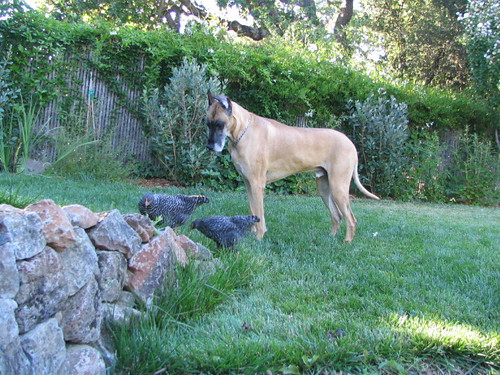
2 of 3: Argus and the girlsGoing into this chicken-farming thing (or egg-farming thing, depending on your point of view), one of my biggest concerns was that we were somehow or another going to hurt or damage or even, gulp, fatally injure one of our chickens out of best intentions but poor execution.

Prior to owning Sophia and ZsuZsu, I'd never had much experience being around birds that still had feathers on them. Sure, I'd seen plenty of birds in my life, but the only time I'd ever touched a live bird was only very recently: two years ago at a local festival there was a guy with a parrot who let me "hold" the bird in my hand for a moment. I couldn't get over how such a big colorful bird could be such a light-weight! Of course, my analytical, logical side was unimpressed, but my emotional side was floored at the whole thing. I came away from that brief encounter with a profoundly different view on the whole bird world.

So, as LeftCoastMom and I talked about getting chickens of our own last Winter, my biggest fears revolved around inadvertently doing something that would kill them. Just take a look around at our house plants, or lack thereof, and you'll understand where this fear was coming from.

Sure, we've owned a Great Dane (named Argus) for eight years now and he seems to be doing fine. Sure, he's a real princess that needs a soft bed to sleep on and won't go outside willingly if there's anything but bright blue skies and needs his food prepared just so.

But these chickens are small birds that needed to be cooped and protected from predators and provided fresh water at all times, etc, etc. And what if it got too cold or rained too much or got too windy? They'd be stuck outside!

Turns out I've been projecting the relative frailty of our large breed dog onto the girls needlessly. The chickens are actually a lot more resilient than he is!

This winter, as the temperatures have hovered around freezing, the girls are showing no signs of distress whatsoever. They're always out and scratching around at dawn, no matter how much frost is on the ground around them.

There have been times this winter when it's rained all day, and the Argus has cowered on his comfy bed indoors refusing to go out to relieve himself no matter how big his bladder has to stretch to keep him indoors. Where are the girls? Scratching around in the rain, seemingly enjoying themselves tremendously as the drops come down and make the dirt all the easier to move around.

Nothing seems to faze them, and through it all, they're quite the little egg-laying machines, too.

What more could I ask for? Well, maybe they could teach the dog how to weather the elements a bit better.

Monday, January 14, 2008

another 50 pounds of chicken feed into the bin

We opened up another fifty pound bag of Purina Layena Crumbles, so it's time for my usual "I just bought food, how much does a yard-fresh egg cost us?" post:

With this bag of food, our girls have now consumed one hundred fifty pounds of laying feed in the four months since our first egg back on September 8, 2007.

Doing a little back-of-the hand calculation, that means we'll go through almost a quarter ton of chicken feed in a year. At $12 per 50-lb bag, that means we'll be paying approximately $120 in feed costs for a year's worth of eggs.

If our two girls continue to average a dozen eggs a week between them, we'll be looking at approximately 50 dozen eggs over that year.

That means each dozen will cost us approximately $2.40 (leaving out the sunk costs to purchase their Eglu).

Not a bad price for a dozen delicious eggs!

Oh, and I noticed something odd on my receipt from San Mateo Pet Supply (where I buy our chicken feed). I'd decided to treat the girls with a couple pounds of hen scratch in addition to the Layena Crumbles.

While the Crumbles were not taxed, the hen scratch was taxed. What up with that? I guess chicken snacks are like people snacks: taxable!

Friday, January 11, 2008

Chicago's Chicken Lady makes a difference!

It was with a big smile on my face that I read the can't-miss article, "Don't Call Her Chicken,"in today's Chicago Sun Times.

Why the smile? The article and its accompanying video is all about how Linda, a regular commenter here on the Urban Chickens blog, is making a difference in the fight to keep chickens legal in Chicagoland.

I've gotten to know Linda through her comments here on the blog, and I can see that she's just as enthusiastic about urban chicken farming in Illinois as we are in California. After all this time communicating by text, it's delightful to actually see her (and Maisy, Betty and Selma) interviewed in the video. Although all that snow on the Eglu makes me shiver!

If I had to think of an ambassador for the Urban Chicken movement, I'd put Linda's name at the top of the list.

Keep up the great work, Linda! Let us know how we can help you keep your chooks legal in Chicago.

LinkWithin

Related Posts with Thumbnails